Table Of Content
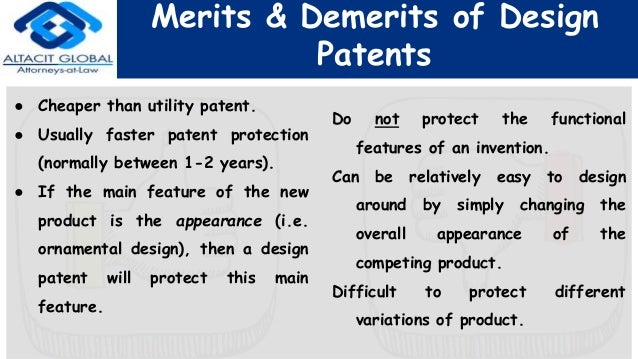
So while a design patent cannot protect any underlying function, it can protect against a competitor copying the appearance of your product. The threat of patent litigation will make any would-be infringer think twice about copying your product design. In this article, I’ll explain why a design patent may be a good initial choice for startups and inventors working with a limited budget and on a tight timeline. While a utility patent has a term of 20 years from the date of filing, a design patent lasts for 15 years from the date the patent is issued. During that time period, the patent holder may have to pay maintenance fees to maintain the patent. According to the USPTO, more than 90% of all patents granted are utility patents.
“What is the Design Patent Application Process?”
We look forward to being your dedicated partner in this exciting journey of innovation and protection. For an invention to qualify for a utility patent, it must meet certain criteria. Primarily, it must be novel, implying that the invention doesn’t exist already in the public domain. It also must be non-obvious, meaning that the invention should not be an obvious idea or modification to someone with knowledge and experience in the relevant technical field.
Design Patents Do the Trick
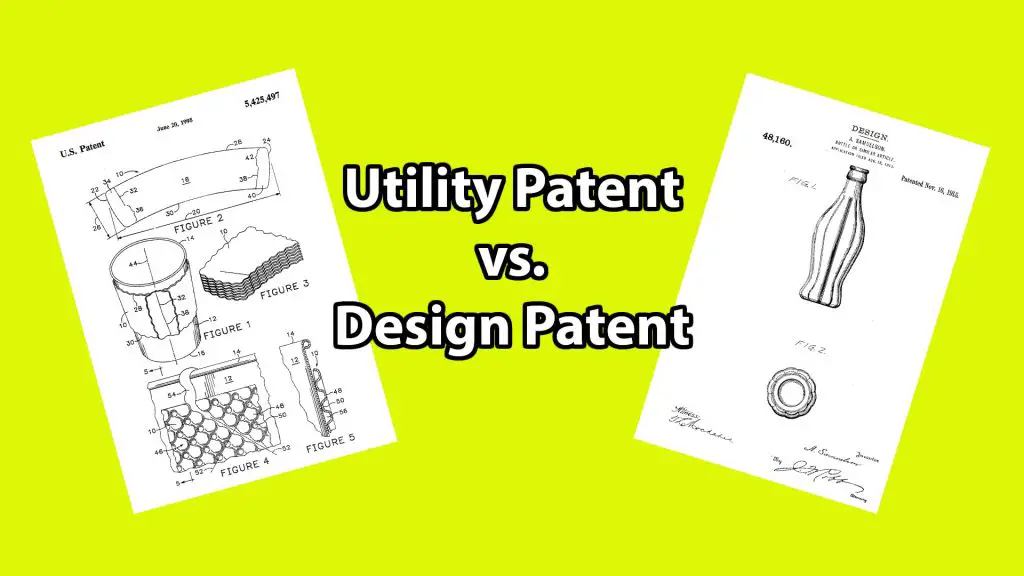
According to stats from the USPTO, utility patent applications take on average 24.2 months to either get approved or denied by the USPTO. Design patents typically take 20.4 months to either get approved or denied by the USPTO, so design patents are often quicker to get from the patent office. In contrast to utility patents which focus on functionality, a design patent protects the ornamental appearance or visual characteristics of an item. This can include aspects like shape configuration or surface ornamentation applied to consumer goods. If you’re concerned about competitors copying the appearance of your concept, then apply for a design patent.
Nonprovisional (Utility) Patent Application Filing Guide
Fees are subject to change, and the applicant should consult the current fee schedule before filing the application. Patent drawings are an integral part of the patent application and are designed to support your claim set within your application and provide your Examiner with an understanding of how your invention is created and used. To provide one example of utility patent drawings, I will use software.
A nonprovisional application for a utility patent must contain at least one claim. The claim or claims section must begin on a separate physical sheet or electronic page. If there are several claims, they must be numbered consecutively in Arabic numerals.
What Does a Utility Patent Cover?
One view must not be placed upon another or within the outline of another. All views on the same sheet should stand in the same direction and, if possible, stand so that they can be read with the sheet held in an upright position. A moved position may be shown by a broken line superimposed upon a suitable view if this can be done without crowding; otherwise, a separate view must be used for this purpose.
To get a design patent, inventors of new designs are required to apply using a design patent application. Unlike utility patents where inventors can use a provisional utility patent application, inventors don’t have the option of filing a provisional design patent application, instead they must apply using a regular design patent application. And if that doesn’t sound good enough, design patents, unlike utility patents, do not have USPTO maintenance fees due after the patent has been issued. Once a non-provisional application is filed, the USPTO will assign a patent examiner to your case who will conduct a search and examination of the application.
Is Federal Circuit on the verge of upending harmonious co-existence between design patents and utility patents? - Reuters
Is Federal Circuit on the verge of upending harmonious co-existence between design patents and utility patents?.
Posted: Mon, 31 Jul 2023 07:00:00 GMT [source]
You'll have six months after the American filing to extend the claim elsewhere. Almost 90% of patent applications receive a rejection with their first office action. About 50-60% of patents are approved, meaning about half of the applications receive approvals after initially receiving a rejection. If an applicant is successful in making this showing, he will be awarded with a utility patent that protects the invention for 20 years from the filing date of his utility patent application. Just remember that if you obtain a patent from the USPTO, you’re invention is only protected in the United States. To protect your invention abroad, you must file a patent application in every country you want to be protected in.
Obtaining a receipt for documents mailed to the USPTO
This goes to show the importance of protecting your intellectual property with not only a utility patent, but also a design patent. Protecting your IP with a design patent and offering good drawings that clearly illustrate your design makes it easier for you to show infringement if a third party copies your IP. Design patents are particularly important if your design provides your product with a competitive edge. Said differently, if your customers would be satisfied with a competitor’s products that has an appearance that’s different than yours, it’s probably not worth your time and money to patent your design. However, if the appearance of your product is something that draws consumers to your product, obtaining a design patent is extremely import for you to maintain your competitive edge. Utility patents protect how inventions, machines, processes, and software work and how they’re used.
You should work with an experienced patent attorney to complete the patent application process and to assist with the various detailed legal decisions that will likely need to be made along the way. By leveraging the item-based documentation approach in MatrixALM, you can streamline the application for utility or design patents, effectively manage the patent review process, and ensure compliance with regulatory requirements. If approved, your utility patent can protect your IP from unauthorized use or duplication for up to 20 years. However, that period is not a given, as you must make periodic payments to keep the patent enforced. In the United States, these maintenance fees are due 3.5, 7.5 and 11.5 years after the patent grant date. There is a six-month grace period following each of these deadlines, during which you can pay a surcharge to preserve your patent rights.

Problems with the utility requirement typically arise in one of two ways. Firstly, issues may come up when an applicant does not identify any specific or substantial utility or does not provide sufficient information for the invention’s use to be apparent in the application. Secondly, problems may arise when the invention’s usefulness is not credible. Determining which type of patent is right for your invention depends on several factors, including the nature of your invention, your budget, and your long-term goals.
Consider the infamous patent infringementdispute between Apple and Samsung.Part of why the case lasted so long — the massive legalbudgets of both parties notwithstanding — was that bothdesign and utility patents came under scrutiny. The two tech giantsbattled for seven years across multiple jurisdictions, suits andcountersuits before finally settling in 2018, with a final award of$539 million to Apple. Design patents expire 15 years from the issue date and require no renewal payments. Utility patents generally expire 20 years from the filing date if the three required maintenance fees are timely paid.